The commercial real estate landscape is experiencing a massive wave of transformation. As urban centers become denser and e-commerce infrastructure demands rapid regional distribution hubs, the race to secure viable real estate has intensified. For developers, investors, and expanding corporations, locating raw acreage is only the first step in a complex, multi-layered puzzle. The true challenge lies in identifying real estate that aligns with modern zoning regulations, environmental protections, and structural feasibility metrics.
Navigating this competitive environment requires moving past casual real estate listings and deploying data-driven, systematic procurement strategies. A single oversight during the initial land acquisition phase, such as a hidden environmental restriction, an unmapped utility constraint, or a miscalculated grading requirement, can instantly turn a promising commercial venture into an unbuildable financial burden. This comprehensive operational blueprint delivers specific, actionable strategies to help you uncover off-market opportunities, vet subsurface and environmental variables, manage early site preparation logistics, and protect your commercial investment against long-term operational liabilities.
Deploying Advanced Acquisition Strategies for Raw Real Estate
Mapping High-Yield Growth Corridors and Accessing Off-Market Commercial Parcels
Relying solely on public commercial real estate databases is a guaranteed way to overpay for land or end up with highly contested, picked-over parcels. The most lucrative commercial developments are built on land acquired before it ever hits the open market. Uncovering these hidden gems requires a deep understanding of municipal infrastructure growth plans, highway expansion maps, and regional demographic shifts.
To build an unshakeable land pipeline, developers must master the tactical methodologies of how to find land for development. This involves analyzing local geographic information system (GIS) data to identify underutilized parcels, tracing outdated zoning overlays, and launching direct outbound mail campaigns to multi-generational landowners. By intercepting owners before they list their properties publicly, you eliminate competitive bidding wars and negotiate highly favorable purchase options that protect your upfront capital.
-
Audit Municipal Capital Improvement Plans (CIP): Review city council records and public works documents to identify where new sewer lines, water mains, and roads are scheduled for installation over the next five years.
-
Track Regional Transportation Sub-Market Data: Target parcels located near upcoming highway interchanges or major logistics bypass lanes before the infrastructure construction phase begins.
Navigating Environmental Risks and Zoning Safeguards
Evaluating Hydrological Hazards and Securing Multifaceted Asset Protection Policies
Once a potential commercial parcel is located, your due diligence team must instantly shift its focus toward environmental risk management. Water is a developer’s greatest ally and most dangerous enemy. Hidden wetlands, seasonal floodways, and changing environmental regulations can permanently halt a project, making a deep understanding of local water table history and federal environmental protections absolutely non-negotiable.
When assessing low-lying commercial land or parcels located along coastal distribution routes, you must determine the long-term financial impact of mandatory flood insurance programs. Working closely with engineers to review Federal Emergency Management Agency (FEMA) flood maps lets you calculate your future premium overhead before finalizing a land purchase. This early financial audit ensures that high recurring asset-protection costs won’t permanently ruin your property’s net operating income (NOI).
-
Analyze High-Resolution FEMA Flood Insurance Rate Maps (FIRMs): Identify whether your prospective building footprint sits inside a Special Flood Hazard Area (SFHA), which demands expensive structural elevations and mitigation systems.
-
Order Independent Phase I Environmental Site Assessments (ESA): Hire certified environmental scientists to audit the land’s historical use, checking for hidden soil contamination, past fuel storage leaks, or illegal waste dumping.
Verifying Boundary Precision and Subsurface Infrastructure

Executing Definitive Boundary Verifications and Mapping Essential On-Site Utilities
You can never take a seller’s word, or an old fence line, as truth when purchasing millions of dollars of commercial real estate. Encroachments, overlapping deeds, and undocumented utility easements can shrink your buildable footprint, and ruin your parking ratios.
Before your earnest money deposit becomes non-refundable, you must deploy licensed land surveyors to execute a comprehensive ALTA/NSPS survey. These highly specialized engineering professionals will precisely locate all property lines, map out hidden utility lines running through the acreage, and verify any active access easements. Having this definitive, certified data ensures that your proposed architectural designs can legally fit onto the physical land.
-
Demand a Certified ALTA/NSPS Land Survey: Secure a highly detailed property map that details every structural improvement, utility easement, and public right-of-way boundary touching the land.
-
Verify Title Commitment Exception Documents: Cross-reference your survey visual mapping records with the title company’s exception sheet to identify and remove any restrictive historical land covenants.
Managing Rural Utility Infrastructure and Water Supply Logistics
Engineering Deep Source Aquifer Access and Calibrating Commercial Fluid Pressures
Many of the most profitable commercial developments, such as regional fulfillment centers, industrial manufacturing facilities, and hospitality retreats, are built outside the immediate reach of municipal water systems. Developing these rural or semi-rural commercial parcels requires establishing a self-contained, high-capacity private water infrastructure network right on site to manage daily operations and fire suppression needs.
To ensure your development has an unshakeable, clean supply of water, you must source certified local pump installers to manage your deep well drilling and fluid distribution logistics. These specialized mechanical technicians understand the exact geology of local aquifers, allowing them to install high-capacity submersible pumps, commercial filtration loops, and massive pressurized storage tanks. Having a reliable, high-volume water source is an absolute requirement for passing strict local commercial building inspections.
-
Execute High-Volume Well Production Drawdown Tests: Confirm your on-site wells can sustain the high gallons-per-minute (GPM) requirements demanded by your facility’s daily operations and automated emergency fire sprinkler networks.
-
Install Multi-Stage Industrial Filtration Array Systems: Implement specialized water testing procedures to catch heavy mineral content or biological contaminants, deploying automated treatment setups to guarantee potable water safety.
Coordinating Initial Site Prep and Environmental Remediation
Executing Strategic Biomass Clearing and Balancing Advanced Cut-and-Fill Grading Designs
Moving from a raw, wooded parcel to a construction-ready commercial pad requires an incredible amount of heavy machinery and precise land management. Unmanaged vegetation, massive tree root systems, and unpredictable surface boulders must be cleared away before foundation excavation can safely begin.
Managing this initial construction phase requires hiring heavy equipment operators to perform comprehensive lot clearing and structural root grubbing across your entire building envelope. This process must be done carefully to protect native trees outside the construction zone, prevent severe soil erosion, and prepare the terrain for mass grading.
-
Secure Commercial Environmental Tree Removal Permits: Ensure your land clearing plan aligns fully with local canopy preservation ordinances and municipal environmental mitigation guidelines.
-
Utilize Heavy-Duty Forestry Mulching Equipment: Deploy high-capacity rotary mulchers to convert cleared biomass into protective ground cover, preventing intense site erosion during early construction.
Engineering High-Traffic Outdoor Hardscape Infrastructure

Designing Rigid Exterior Interlocking Matrices and Managing Heavy Axial Load Distributions
The success of a modern commercial asset, whether it’s an upscale open-air lifestyle center, a premium corporate campus, or a luxury multi-family development, relies heavily on the durability and aesthetic appeal of its external spaces. Pedestrian walkways, outdoor plazas, and main entrance drop-off zones endure constant foot traffic and heavy vehicle loads, requiring highly durable hardscape engineering.
To achieve an ideal balance of visual appeal and structural strength, developers should partner with a certified commercial paver contractor to build out high-traffic common areas. Unlike simple, monolithic asphalt surfaces that crack under thermal stress, interlocking concrete pavement systems offer excellent flexural strength and allow for easy underground utility access. Ensuring these exterior hardscapes are engineered with heavy-duty base layers protects your walkways from settling, shifting, and shifting over time.
-
Specify Interlocking Concrete Pavers with High Aspect Ratios: Choose thick, heavy-duty pavers specifically engineered to withstand regular vehicular turning forces and heavy delivery truck wheel loads.
-
Engineer Multi-Layered Aggressive Crushed Stone Bases: Lay a highly compacted sub-base of open-graded stone to provide maximum structural support and facilitate fast, clean groundwater drainage.
Integrating Commercial Outdoor Spaces and Public Amenities
Constructing Multi-Level Gathering Plazas and Implementing Advanced Permeable Drainage Schemes
Modern commercial real estate trends heavily favor developments that blur the line between indoor workspaces and outdoor public amenities. Corporate tenants demand functional outdoor dining areas, open-air presentation zones, and walkable green spaces to support employee wellness and boost collaboration.
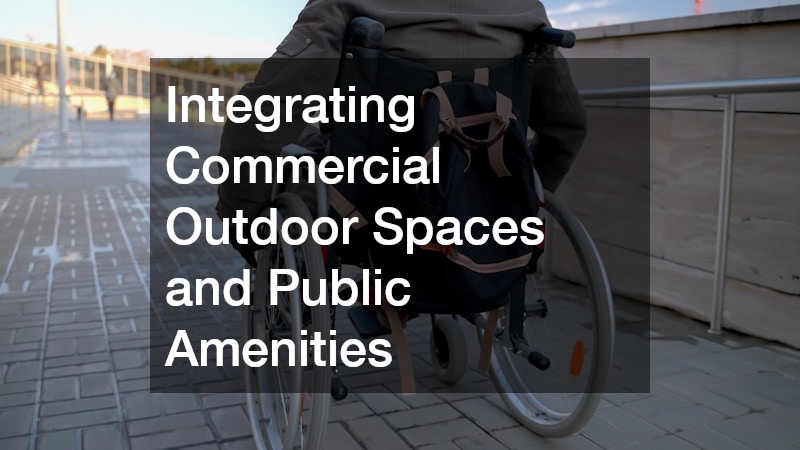
Integrating these high-end public spaces into your master site plan requires a meticulous approach to professional patio installation layout designs and advanced drainage engineering. These public gathering plazas must be built to handle extreme weather conditions, provide full ADA accessibility, and incorporate smart sub-surface drainage systems that prevent hazardous puddling. A well-designed outdoor common area drastically improves a property’s lease rates and keeps tenants happy for years.
-
Enforce Strict Universal ADA Slope Compliance Guidelines: Ensure all outdoor gathering spaces maintain a grade of less than 2% to guarantee safe access for mobility devices.
-
Deploy Hidden Sub-Surface Slotted Drainage Systems: Integrate low-profile, high-volume trench drains into your hardscape perimeters to quickly clear away heavy rainwater without breaking up the visual design.
Mitigating Risk via Multi-Layered Commercial Insurance Portfolios
Partnering with Elite Corporate Underwriters and Structuring Robust Liability Protections
The financial risks of commercial land development don’t vanish once construction wraps up; they simply evolve. Moving from the construction phase into active property operations introduces a whole new world of liabilities, including tenant slip-and-fall incidents, structural building failures, and unexpected natural disasters.
To shield your investment capital from these unpredictable events, you must partner with an elite, highly rated commercial insurance provider during the early planning stages of your development. A specialized corporate underwriting firm will analyze your building’s specific risk profile, helping you assemble a comprehensive insurance portfolio that covers everything from builder’s risk protection during construction to high-limit commercial general liability (CGL) coverage once the property opens.
-
Secure Comprehensive Builder’s Risk Insurance Extensions: Protect your construction materials, temporary job-site structures, and heavy machinery from theft, vandalism, and storm damage throughout the development cycle.
-
Structure High-Limit Commercial General Liability (CGL) Policies: Establish multi-million dollar umbrella liability cushions to protect your development group from devastating injury or property damage claims.
Transitioning Assets to High-Performance Property Management
Establishing Proactive Preventive Upkeep Manuals and Managing Long-Term Tenant Accounts
The moment your construction crews hand over the keys, your commercial asset enters its most critical phase: operational property management. Keeping a newly built commercial facility profitable requires an ongoing, highly detailed commitment to preventive maintenance, tenant relations, and lease administration.
To protect your newly developed asset and maximize its long-term financial returns, you must set up an on-site office or partner with a professional property management group before your first tenant moves in. A skilled management team will take full control of day-to-day operations, including managing vendor service contracts, running regular HVAC and life-safety inspections, and building an emergency financial reserve. Taking this organized approach to asset care maintains your building’s physical appeal, reduces vacancy rates, and maximizes your property’s total investment value.
-
Develop a Digital Preventive Maintenance Manual: Create a unified cloud schedule to track and execute regular service calls for roofing systems, elevator mechanics, and complex HVAC infrastructure.
-
Establish Transparent Triple-Net (NNN) Common Area Accounting: Implement clear CAM (Common Area Maintenance) accounting practices to pass operational expenses on to tenants fairly and accurately.
Optimizing Specialized Multi-Family Lease-Up Lifecycles
Deploying Professional Leasing Agents and Maximizing Tenant Retention Protocols
For developers specializing in large-scale multi-family projects, residential high-rises, or mixed-use retail communities, the initial transition from construction to occupancy requires a highly focused marketing strategy. Unlike a single-tenant office building, filling a multi-family property requires managing hundreds of individual tenant accounts, coordinating rapid move-in schedules, and executing aggressive local marketing campaigns.
To run these fast-paced residential lease-up operations smoothly, you need to hire a highly experienced local rental property manager who understands your specific target demographic. This localized leasing expert will help you set optimal market-rate rents, deploy targeted digital advertising, and establish thorough tenant screening processes to protect your community’s safety. Securing high occupancy rates within the first six to twelve months of opening satisfies your lenders’ underwriting goals and lets you transition smoothly to long-term permanent financing.
-
Launch Pre-Leasing Digital Marketing Campaigns: Build an extensive waitlist of prospective tenants by showcasing interactive 3D virtual property tours and floor plans online well before construction wraps up.
-
Implement Strict Automated Tenant Screening Background Checks: Set up standardized digital background, credit, and income verification checks to secure high-quality tenants and keep eviction rates low.
Succeeding in the high-stakes world of commercial land development requires a flawless blend of strategic foresight, rigorous technical due diligence, and highly disciplined project management. By taking a systematic approach to land procurement, moving from analyzing municipal growth trends and verifying exact boundary lines to engineering high-capacity private utilities and clearing raw terrain, you protect your investment group from hidden liabilities and set the stage for a smooth construction cycle.
Ultimately, a commercial development’s true financial value is realized through its long-term operational performance and ability to generate consistent cash flow. Partnering with elite engineering professionals, experienced local utility technicians, and top-tier property management groups transforms raw land into a highly valuable, market-resilient commercial asset. Commit to absolute mechanical precision, maintain a strict culture of regulatory compliance, and deploy data-driven management frameworks; by doing so, you will ensure your commercial development project stays fully optimized, generates maximum returns, and delivers an undeniable competitive advantage for decades to come.